Reading Cognitive Decline Off an EEG: The Quiet Rise of Brain-Aging Biomarkers
Two new GeroScience studies suggest that low-cost scalp recordings — paired with machine learning — can flag amnestic MCI and stage Parkinson's with startling accuracy. The catch: it's early.
The most interesting wearable in the brain-aging conversation right now isn't a ring, a patch, or a smartwatch — it's the humble EEG cap, the same mesh-and-electrode rig that has lived in neurology labs for decades. What's new isn't the hardware. It's what researchers are now able to read off the signal. Two fresh papers in GeroScience hint that with the right stimuli, the right math, and a machine-learning model trained on the result, a few minutes of scalp recording may be enough to flag the earliest stages of cognitive decline and to stage Parkinson's progression. The work is early — genuinely early — but the trajectory matters for anyone serious about optimizing the long arc of how a brain ages.
- Sensory-evoked potentials look promising. A multi-modal EEG pipeline classified amnestic mild cognitive impairment with 96.1% accuracy in a small study.
- Entropy is the new signal. Task-based EEG entropy features distinguished Parkinson's patients with freezing of gait from healthy controls at up to 96.15% accuracy.
- Combining modalities beats any one stream. Auditory, visual, and somatosensory data together outperformed any single sense.
- This is research, not a clinic offering. Both studies are small, single-cohort, and not yet validated for individual diagnosis.
- Talk to a clinician. If memory or motor changes concern you, the validated workup still runs through neurology — not consumer hardware.
What the first study actually showed
The first paper, led by Zhang and colleagues, asked a simple question with sophisticated tools: can the brain's automatic response to sights, sounds, and touches reveal who is sliding toward Alzheimer's-type decline? The team recorded event-related potentials — the tiny voltage blips that follow a stimulus — from people with amnestic mild cognitive impairment (aMCI) and healthy controls, then fed both the amplitudes and the functional-connectivity patterns into an interpretable support vector machine. The reported classification accuracy reached 96.1%, with 97.7% sensitivity and 94.3% specificity when all three sensory modalities were combined.
Two features did most of the work. ERP amplitudes were blunted in the aMCI group — the brain's evoked response was quieter, as if the volume knob on incoming signals had been turned down. And the connectivity map was rearranged in a telling way: higher phase-locking in frontal regions, which tracked with worse cognitive performance, and lower connectivity in posterior regions across delta through alpha frequencies. Frontal overdrive paired with posterior under-coupling is a pattern that fits the broader neuroscience of early Alzheimer's — the brain working harder up front to compensate for fading back-of-head processing.
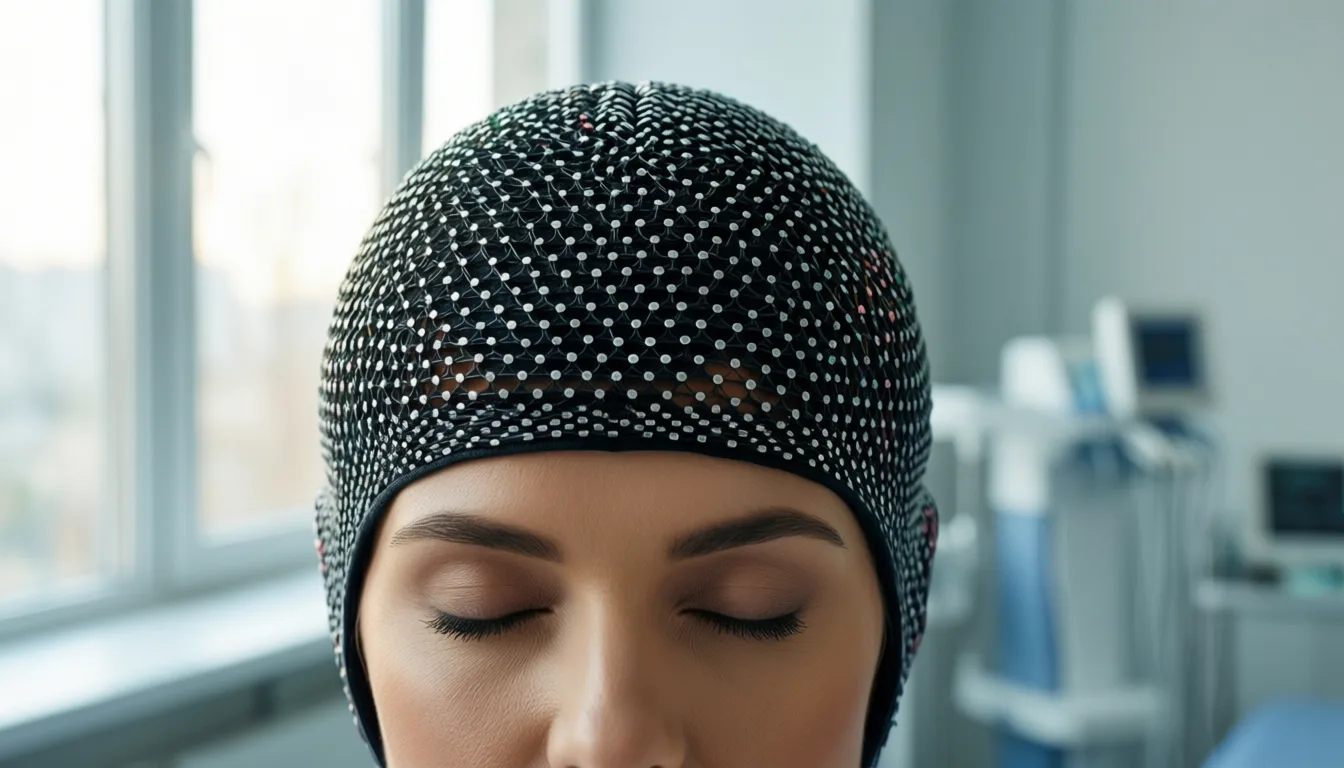
Multi-sensory ERP recordings are non-invasive, fast, and — in principle — cheap to scale.
The brain's evoked response was quieter, as if the volume knob on incoming signals had been turned down.
And the second: entropy as a window into Parkinson's
The second paper, by Onay and Karaçalı, takes a different angle on a different disease. Instead of measuring how big the brain's response is, the authors measured how complex it is — the moment-to-moment unpredictability of the EEG signal while participants performed a lower-limb pedaling task. They compared healthy controls, people with Parkinson's disease, and people with the more advanced subtype that involves freezing of gait (PDFOG).
The pattern was consistent. Both Parkinson's groups showed reduced permutation entropy in frontal and parietal regions, and diminished entropy variability in occipital and left frontal areas — signatures the authors interpret as a brain less able to flexibly allocate neuronal resources to the task in front of it. When entropy-derived features were handed to LDA and SVM classifiers, the model distinguished healthy controls from PDFOG patients with up to 96.15% accuracy.
Put the two papers next to each other and a quiet thesis comes into view: machine learning is extracting a clinically useful signal from EEG features that human readers have historically struggled to use. Amplitudes for one disease, entropy for another — but in both cases, a low-cost recording paired with a smart classifier separated groups with accuracy that, if it holds up, would be very interesting indeed.
Why this is exciting — and where to slow down
The appeal here is obvious. MRI is expensive. Cerebrospinal-fluid biomarkers require a lumbar puncture. PET amyloid scans are powerful but rationed. EEG, by contrast, is portable, non-invasive, and already sitting in countless clinics. If a 20-minute multi-sensory protocol could meaningfully shorten the path to a workup for someone whose memory is starting to slip — or help neurologists stage Parkinson's more precisely — that is a real win for the brain-aging clinic of the near future.
But "early" is doing a lot of work in that sentence. Both studies are single-cohort and modest in size. Accuracy numbers from a tightly controlled study population almost always shrink in the messier real world, where comorbidities, medications, sleep deprivation, and head shapes all add noise. Neither paper establishes that these signatures show up before clinical symptoms, which is what an early-warning tool ultimately has to do. And neither has been replicated across independent labs, scanners, or demographics. The convergence between the two studies — different diseases, different features, similar machine-learning playbook — is encouraging, but it is convergence of method, not yet of validated clinical claim.
For the looksmaxing-adjacent reader who treats brain health as another long-horizon optimization project, the practical takeaway is restraint. You cannot buy this protocol. The consumer EEG headbands on the market are not running the multi-sensory ERP pipelines or the entropy analyses described in these papers, and no headband on Amazon should be interpreted as screening you for MCI or Parkinson's. The validated levers for cognitive aging remain the unsexy ones: sleep architecture, cardiorespiratory fitness, blood-pressure control, hearing correction, and showing up to your annual checkup. The EEG cap is coming. It just hasn't arrived.
Still, the through-line is worth holding onto. The brain leaks information about how it's aging through signals we've been recording for nearly a century — we just hadn't known how to listen. Machine learning is changing that, and the next decade of brain-aging medicine will likely be defined less by exotic new hardware than by smarter readings of the tools already on the shelf.
Frequently asked questions
How accurate was the EEG test at detecting early Alzheimer's-type cognitive decline?
When all three sensory modalities were combined, the multi-sensory ERP pipeline classified amnestic mild cognitive impairment with 96.1% accuracy, 97.7% sensitivity, and 94.3% specificity. Two features drove most of that performance: blunted ERP amplitudes in the MCI group and a rearranged connectivity map marked by higher phase-locking in frontal regions and lower connectivity in posterior regions.
Why did using auditory, visual, and touch stimuli together produce better results than any single sense?
The article states that combining auditory, visual, and somatosensory data outperformed any single sensory stream, though it does not detail the precise mechanism behind that improvement.
Can I use a consumer EEG headband to screen myself for MCI or Parkinson's?
No. The article is explicit that consumer EEG headbands are not running the multi-sensory ERP pipelines or entropy analyses described in the research papers, and no headband available on the consumer market should be interpreted as screening for MCI or Parkinson's.
What are the main limitations of these studies?
Both studies are single-cohort and modest in size, and accuracy numbers from tightly controlled study populations almost always shrink in the messier real world due to comorbidities, medications, sleep deprivation, and other noise. Neither paper establishes that the identified signatures appear before clinical symptoms, and neither has been replicated across independent labs, scanners, or demographics.
What would need to happen for this EEG approach to become a standard clinical tool?
The article identifies three requirements: replication in larger and more diverse cohorts, prospective data showing the signatures appear before clinical diagnosis, and head-to-head comparison against existing blood and imaging biomarkers.
Join the conversation
Comments are moderated and reviewed before they appear. Be constructive — this is health information.
Add your comment