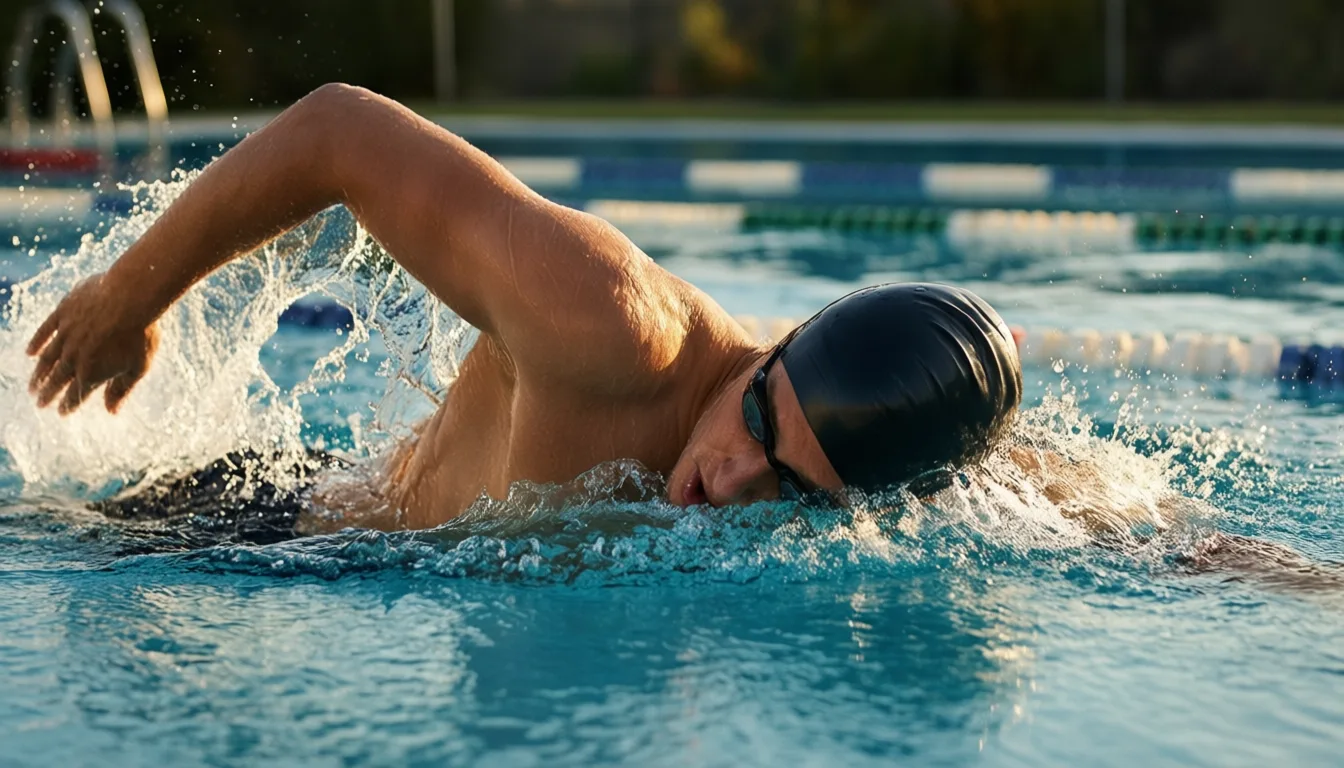
A Smarter Rotator Cuff Routine: What Competitive Swimmers Reveal About Shoulder Longevity
A randomized trial in elite swimmers tested a twice-weekly, 12-week prehab block — and the torque ratios it preserved point to a protocol overhead athletes and desk-bound lifters can borrow.
The shoulder is the joint that endurance sport asks the most of and protects the least. A competitive swimmer can rack up tens of thousands of overhead rotations in a single training week; a CrossFitter snatching twice a week or a developer hunched at a sit-stand desk asks less in volume but often more in asymmetry. The common failure mode is the same — a quiet drift in the balance between the muscles that drive the arm forward and the smaller ones that brake and stabilize it. A new randomized controlled trial in competitive swimmers offers something rarer than another warning about that drift: a tested, time-boxed protocol that appears to slow it down.
Published in Healthcare, the trial randomized competitive swimmers aged 16 to 35 with no prior shoulder complaints into three groups. Two experimental groups performed the same five-exercise rotator cuff program twice a week for 12 weeks — one with free weights, the other with elastic bands. A control group performed a sham routine. Researchers measured the concentric and eccentric peak torque of the internal and external rotators on an isokinetic dynamometer at three speeds — 60, 120, and 180 degrees per second — before and after the block. The headline outcome wasn't who got stronger. It was who didn't get more imbalanced over a competitive season, as Tavares and colleagues report.
That distinction matters, and it's where the physiology gets interesting.
Why torque ratios, not raw strength, predict trouble
The rotator cuff is a four-muscle committee — supraspinatus, infraspinatus, teres minor, subscapularis — whose job is less to move the arm than to keep the humeral head centered in the glenoid while the big movers (lats, pecs, deltoid) generate force. In swimmers and other overhead athletes, the internal rotators that drive the pull phase get trained relentlessly. The external rotators that decelerate the arm and reset the stroke do not. Over a season, the ratio between them slips.
Sports scientists track two versions of that ratio. The conventional ratio compares concentric external rotation torque to concentric internal rotation torque — essentially, how hard you can pull the arm back versus how hard you can drive it forward. The functional ratio is the more telling one: it compares eccentric external rotation (the brake) to concentric internal rotation (the gas pedal). That's the ratio that mirrors what actually happens at the end of a freestyle pull, a tennis serve, or a barbell push press — a fast-firing prime mover that a smaller, slower antagonist has to decelerate. When the brakes can't match the engine, the joint pays.

The rotator cuff's job is centration, not propulsion — which is why ratio matters more than peak force.
What the trial actually showed
Here is where the careful reading begins. Across the battery of isokinetic tests, the control group — the swimmers doing the sham routine while training and competing as usual — showed statistically significant decreases in rotator peak torque on five separate measures. The two experimental groups, by contrast, showed a significant decrease on only one. The swimmers who completed either preventive program also demonstrated less imbalance in their conventional and functional ratios than controls by the end of the 12 weeks.
Read that again, because the framing matters: the protocol did not turn swimmers into stronger rotators. It largely prevented the seasonal erosion that the control group experienced. In a discipline where the in-season trajectory is reliably downward for cuff balance, holding the line is the win. The authors conclude that a 12-week preventive program minimizes the progressive shoulder rotational imbalance that accumulates over a competitive season.
Equally useful for anyone designing a real-world prehab block: the weighted and banded versions of the program produced broadly similar effects. The trial wasn't powered to crown a winner between implements, and it shouldn't be read that way — but it's a reasonable signal that the movement pattern and dosing are doing more of the work than the equipment.
The protocol didn't make swimmers stronger rotators. It stopped the season from making them weaker ones.
A protocol you can actually adapt
The published trial doesn't hand readers a turnkey home program, and we won't invent one. But the structural choices are worth naming, because they're the parts a reader can carry into a conversation with a coach or physiotherapist: twice-weekly sessions, sustained for a full 12 weeks, built around five exercises targeting the internal and external rotators through both concentric and eccentric work. Notably, the testing protocol assessed torque at 60, 120, and 180°/s — slow, moderate, and fast — which is a reminder that the cuff has to function across a range of contraction speeds, not just the slow tempo most rehab work defaults to.
The translation to non-swimmers is reasonable but not automatic. Throwers, racquet athletes, overhead lifters, and climbers share the same broad demand — high internal-rotation output and an under-trained eccentric brake on the back side. Desk workers carry a related but different problem: chronically internally rotated posture without the training load that builds the engine in the first place. The trial supports the direction of intervention for all of them. It does not prove equivalence.
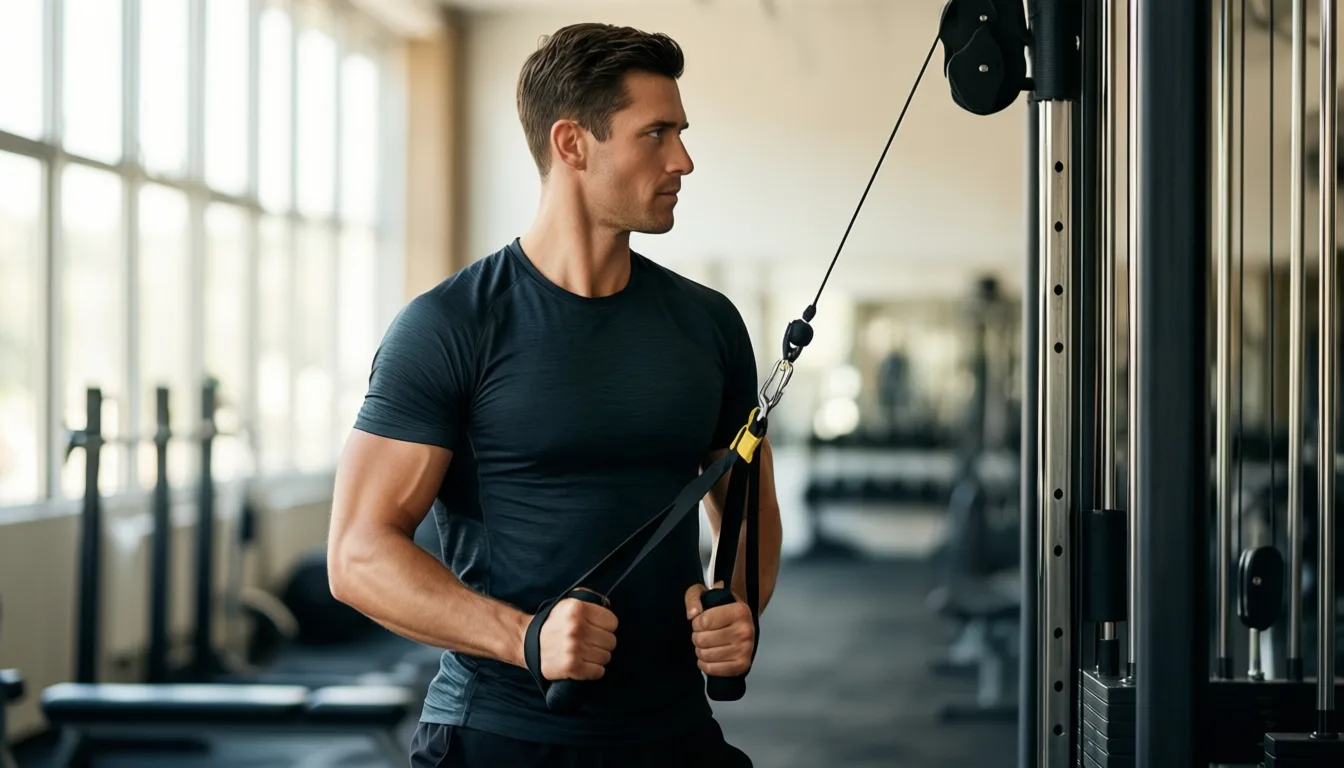
Banded and weighted versions of the program produced broadly similar effects in the trial.
- Ratios, not raw strength. The cuff's job is to brake and stabilize; what predicts trouble is the balance between internal and external rotators, especially the eccentric-to-concentric functional ratio.
- Holding the line counts as winning. The trial's main effect was preventing the in-season decline seen in controls — not boosting peak torque.
- Twice a week, twelve weeks. The tested dose is consistent and unglamorous. Sporadic prehab was not what was studied.
- Bands or weights, similar signal. Implement choice mattered less than movement pattern and dosing.
- Train multiple speeds. Torque was assessed at 60, 120, and 180°/s — a reminder the cuff functions across velocities.
- Evidence is moderate, not definitive. One RCT in healthy young swimmers; generalization to other populations is plausible but unproven.
The bigger lesson for shoulder longevity
The most quietly radical thing about this trial isn't the exercises. It's the timeline. Twelve weeks, twice a week, no in-season heroics — just steady, boring exposure to the right pattern at the right dose. That's a deeply unfashionable prescription in a culture that prefers 20-minute mobility flows and viral single-exercise fixes. The swimmers who held their ratios didn't do anything dramatic. They just did the same five things, on schedule, for a season's worth of weeks.
For overhead athletes and desk-bound lifters alike, that's probably the transferable insight worth keeping. The shoulder is a slow-build joint. The interventions that preserve it look slow and built, too.
Frequently asked questions
Did the rotator cuff program actually make swimmers stronger?
No — the program's main effect was preventing the decline that the control group experienced, not boosting peak torque. The control group showed statistically significant decreases in rotator peak torque on five separate measures, while the two experimental groups showed a significant decrease on only one.
What is the functional ratio, and why does the article say it matters more than the conventional ratio?
The functional ratio compares eccentric external rotation torque to concentric internal rotation torque — essentially the braking force against the driving force. The article describes it as more telling because it mirrors what actually happens at the end of a stroke or serve: a fast-firing prime mover that a smaller antagonist has to decelerate, and when the brakes can't match the engine, the joint pays.
Does it matter whether I use free weights or resistance bands for a program like this?
Based on this trial, the choice of implement mattered less than the movement pattern and dosing. The weighted and banded versions of the program produced broadly similar effects, though the trial was not designed to declare a winner between the two.
Can desk workers or non-swimmers expect the same benefit from a program like this?
The article says the translation to non-swimmers is reasonable but not automatic, and that the trial does not prove equivalence for other populations. It notes that desk workers carry a related but different problem — chronically internally rotated posture without the training load that builds the engine — and that the trial supports the general direction of intervention without proving the results transfer.
What were the basic structure and dose of the program that was studied?
The tested protocol involved five exercises targeting the internal and external rotators through both concentric and eccentric work, performed twice a week for 12 weeks. The article emphasizes that sporadic prehab was not what was studied, and describes the dose as consistent and unglamorous.
Join the conversation
Comments are moderated and reviewed before they appear. Be constructive — this is health information.
Add your comment