
The Two-Minute Walk Break: What a Crossover Trial Found in Older Brains
A randomized crossover study put 27 older adults through three hours of sitting — broken up with single-task or dual-task walking. Cerebral blood flow and cognition shifted in ways worth dissecting.
The chair is not the villain we sometimes make it out to be — but three uninterrupted hours in one does measurable things to an older brain. A new randomized crossover trial asked a sharper question than most sedentary-behavior studies bother with: if you break up that sitting with two-minute walks, does it matter whether the walker is just walking, or walking while doing mental arithmetic? The answer, published this year in GeroScience, is a careful and qualified yes — with the cognitive signal landing more clearly than the cerebrovascular one.
Here is the protocol, because the protocol is the point. Twenty-seven healthy older adults (mean age 69.4, 25 women) reported to the lab on three separate days. Each visit involved three hours of seated time. In the control condition, they simply sat. In the single-task condition, every 30 minutes they stood up and walked for two minutes. In the dual-task condition, those same two-minute walks were performed while continuously subtracting sevens from a randomized three-digit number — a classic cognitive load. Cerebral blood flow velocity (CBFv) at the middle cerebral artery and a battery of cognitive tests — Trail Making A and B, Stroop, and verbal fluency — were measured before each session and again ten minutes after it ended. The order was randomized; participants served as their own controls. That design is the trial's quiet strength: each person's brain is benchmarked against itself, three times over, with the variable being the texture of the movement break, not the existence of one. The full study is in GeroScience.
What actually moved
The headline finding is on the cognitive side. The authors reported a significant condition-by-time interaction for verbal fluency — both phonological and semantic variants — and for Trail Making Test A, the simpler visuomotor scanning task. Translated: how participants changed from pre to post depended on which condition they were in. Sitting alone did not produce the same trajectory as sitting punctuated by walking, and the dual-task and single-task walks did not behave identically to each other. Verbal fluency is a sensitive probe of executive control and lexical retrieval; TMT-A leans more on processing speed. Both improved differentially when walking broke up the sit, per the trial.
What the published abstract does not do is hand us a clean ranking of dual-task over single-task on every outcome, or a dramatic CBFv main effect. The interaction is reported; the magnitude and direction of each pairwise contrast in the full results table is where the nuance lives. For a piece in our Protocols section, that distinction matters. A moderate evidence rating means: real signal, small sample, acute design, narrow population. It does not mean a universal prescription.

Transcranial Doppler measured cerebral blood flow velocity before and ten minutes after each three-hour session.
Why dual-task is interesting, even when it doesn't dominate
The mechanistic bet behind dual-task walking is that loading the prefrontal cortex while the locomotor system is also working drives a different pattern of neurovascular coupling than walking alone. Serial subtraction during gait is not a gimmick — it is a small, repeatable demand on working memory and attentional control, layered onto the postural and rhythmic demands of walking itself. In older adults, that combination is the one most likely to reveal reserve, because the brain has to allocate resources across competing tasks. The plausible upside of dual-task breaks is that they may extract more cognitive benefit per minute than single-task breaks. The plausible downside is that they are harder, less pleasant, and easier to skip.
The Cunha and colleagues trial is best read as a careful first-pass: it establishes that the texture of a movement break — not merely its presence — interacts with how older brains perform afterward. It does not yet tell us whether those acute changes accumulate into anything that matters over months.
The variable here is not whether you move, but the texture of the movement when you do. On the trial's design
How to read this if you program your own day
The protocol is almost embarrassingly cheap. Two minutes of walking every half hour, across a three-hour seated block, is roughly twelve minutes of movement in 180. That is the kind of dose that fits inside a workday without negotiation. Whether you load it cognitively — counting backwards, naming animals, rehearsing a presentation — is a separate lever, and on the evidence so far, a lever worth experimenting with rather than committing to dogmatically.
Two cautions worth holding. First, this was an acute crossover in healthy older adults; the trial measured what happens on the day, not what happens over a quarter. Second, the cognitive battery used here is sensitive but narrow — improvements on verbal fluency and TMT-A do not automatically translate to driving, decision-making, or work performance, though they are reasonable proxies for the underlying systems.
- The design is the story. A within-subject crossover with 27 older adults, three matched three-hour sessions, and randomized order — each participant is their own benchmark.
- The cognitive signal is real but specific. Significant condition-by-time interactions emerged for verbal fluency (phonological and semantic) and Trail Making A, per the trial.
- Dual-task is a hypothesis, not yet a verdict. Loading walking with serial subtraction is mechanistically interesting; the published abstract reports interactions, not a clean dual-task win on every outcome.
- The dose is small. Two minutes every 30 minutes — about 12 minutes of walking inside a three-hour block.
- Evidence is moderate. Acute effects, small sample, healthy older adults. Useful for protocol design; not a substitute for clinical guidance.
- Talk to a clinician before changing routines if you have cardiovascular, balance, or cognitive conditions.
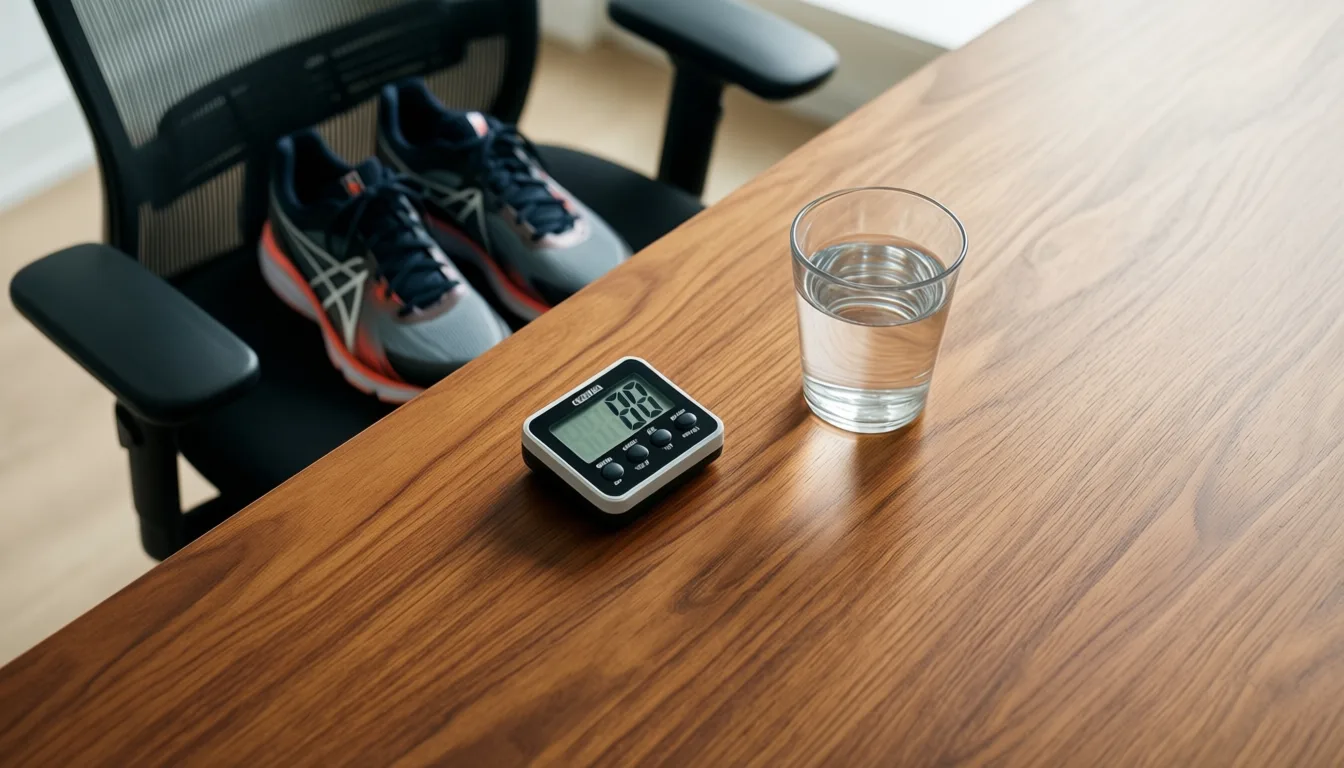
The protocol's appeal is logistical as much as physiological — a timer and a hallway are the entire toolkit.
The reason this trial is worth dissecting, even with its modest sample, is that it asks a question most sedentary-behavior research does not: what kind of break, not just whether a break. That is the question performance-minded readers actually face. The answer the data support, in the register the evidence allows: breaking up prolonged sitting with brief walks measurably interacts with cognitive performance in older adults, and the cognitive content of those walks is a variable worth taking seriously — pending larger, longer work to tell us how much, for whom, and for how long.
Frequently asked questions
What exactly did the dual-task walking break involve?
In the dual-task condition, participants walked for two minutes every 30 minutes while continuously subtracting sevens from a randomized three-digit number. This is described in the article as a classic cognitive load layered onto the postural and rhythmic demands of walking itself.
How much total walking did participants actually do during each three-hour session?
Participants walked for two minutes every 30 minutes across a three-hour block, which adds up to roughly 12 minutes of movement in 180. The article notes this is the kind of dose that fits inside a workday without negotiation.
Which cognitive tests showed significant differences depending on the type of break taken?
The trial found significant condition-by-time interactions for verbal fluency — both phonological and semantic variants — and for Trail Making Test A, the simpler visuomotor scanning task. The article notes that verbal fluency probes executive control and lexical retrieval, while Trail Making Test A leans more on processing speed.
Why does the article treat this trial's design as a particular strength?
The study used a within-subject crossover design, meaning each participant completed all three conditions across separate visits, so each person's brain was benchmarked against itself. The article calls this the trial's quiet strength because the variable being tested was the texture of the movement break, not the existence of one.
What does the article say about applying these findings to everyday routines?
The article urges two cautions: the trial measured acute, same-day effects in healthy older adults, not outcomes over weeks or months, and improvements on the specific cognitive tests used do not automatically translate to real-world tasks like driving or decision-making. It also advises talking to a clinician before changing routines if you have cardiovascular, balance, or cognitive conditions.
Join the conversation
Comments are moderated and reviewed before they appear. Be constructive — this is health information.
Add your comment