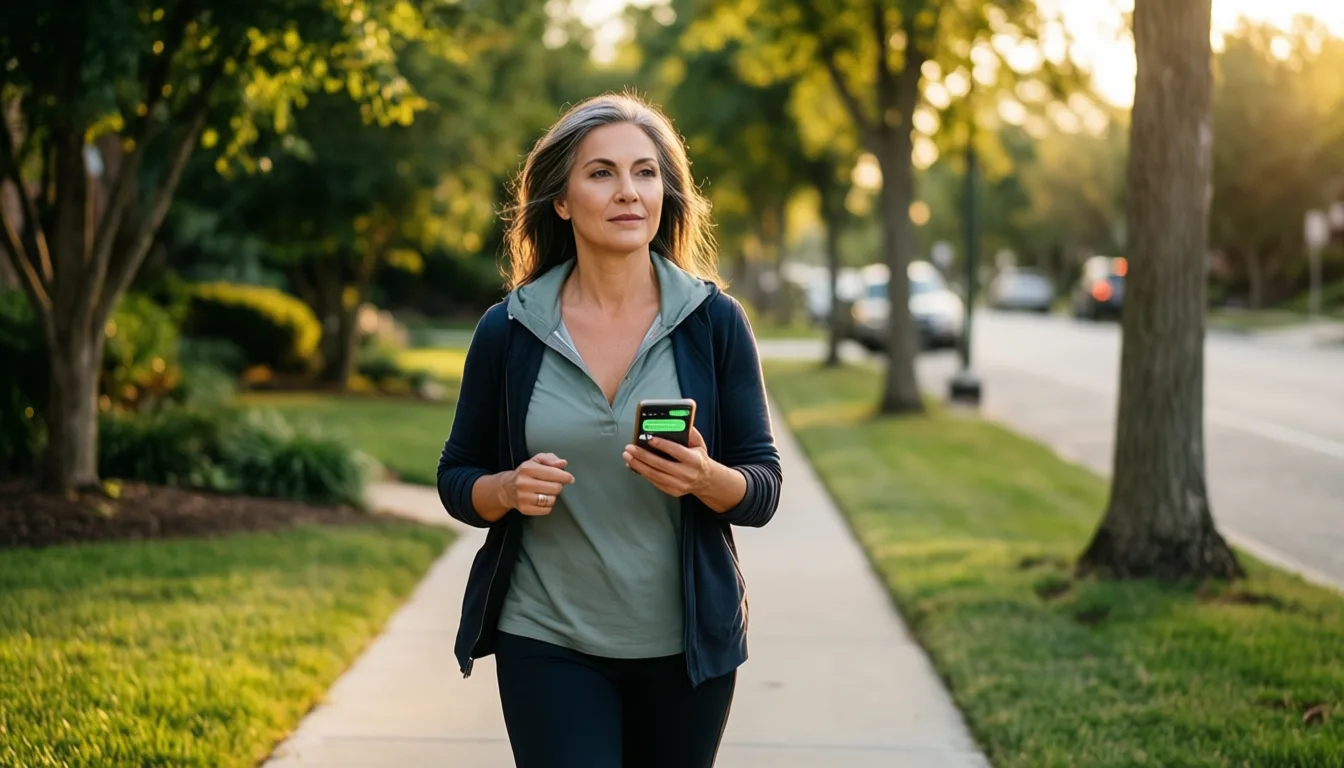
The Walking-Habit Prescription: Texting Caregivers Into 1,000 Steps a Day
A 12-week Northwell trial is testing whether personalized SMS nudges can convert occasional strolls into automatic daily walking among dementia caregivers — a clean readout on the physiology of habit itself.
Habit is the quietest performance enhancer in physiology. It costs nothing, it scales, and once it locks in, the prefrontal cortex stops having to argue with the couch. The question that has bedeviled behavior scientists for a generation is how to manufacture that lock-in on purpose — not in motivated marathoners, but in people whose schedules and stress loads make exercise feel like one more impossible ask. A new 12-week trial out of Northwell Health is taking a swing at exactly that population, and the protocol is worth a close look for anyone who has ever wondered why some routines stick and others evaporate by February.
The study, registered as NCT06803797, recruits caregivers of people living with Alzheimer's disease and related dementias — a group whose physical activity tends to crater under the weight of round-the-clock responsibility. The intervention is, on its face, almost suspiciously simple: personalized text messages, delivered over twelve weeks, built around a stack of behavior-change techniques (BCTs). The endpoint is also unusually specific. Investigators aren't chasing weight loss or VO2 max. They're chasing automaticity — the moment a behavior stops requiring a decision.
That framing matters. Most exercise trials measure output: minutes logged, calories burned, steps counted. This one measures whether the brain has rewritten its default. The operational definition the team is using is precise enough to satisfy a methods nerd: a participant has built the habit when they walk 1,000 or more steps during a one-hour window on seven consecutive days, executed according to a personalized walking plan. Seven days. Same hour. That's the threshold for what the researchers are calling habitual walking.
Why automaticity is the right target
For endurance-minded readers, the mechanism here is more interesting than the dose. A 1,000-step hour is roughly a brisk ten-minute walk — physiologically modest. Nobody is shifting their lactate threshold on this protocol. What the trial is probing is the upstream variable: the cognitive cost of starting. If automaticity can be engineered — if the cue, the context, and the action can be stitched together tightly enough that the behavior fires without deliberation — then the same scaffolding that gets a sleep-deprived caregiver out the door can, in theory, anchor any habit you care about. Tempo runs. Mobility drills. The protein shake you keep forgetting to drink.
The Northwell team has been explicit that automaticity is the key mechanism of behavior change they are trying to move. That is a meaningful methodological choice. It means the trial isn't just asking whether people walked more; it's asking whether walking became frictionless. Those are different questions, and most of the noise in the habit literature comes from conflating them.
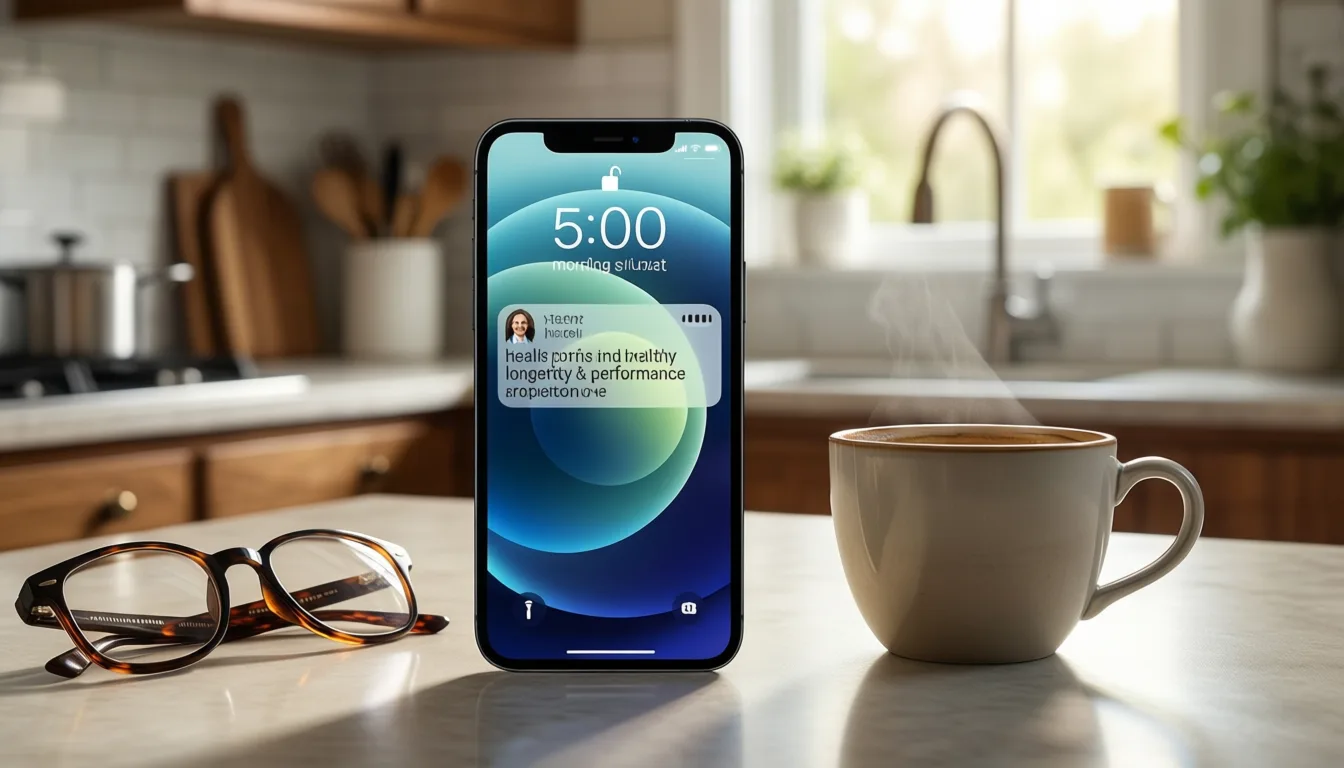
The intervention's only hardware: a phone, a plan, and a well-timed nudge.
The BCT stack, and what it borrows from athletes
Behavior-change techniques are the bricks behavioral scientists use to build interventions: goal-setting, action planning, self-monitoring, prompts and cues, feedback on behavior, social support, and so on. A “multi-component” intervention like this one bundles several together rather than testing them in isolation — pragmatic for a real-world deployment, harder to dissect mechanistically. The Northwell protocol delivers that bundle as personalized text messages, which means the cue arrives in the same channel where modern life already lives: the lock screen.
Performance athletes will recognize most of these moves under different names. A personalized walking plan is implementation intention — the “when X, I will do Y” structure that sport psychologists have used for decades to reduce the activation energy of training. Self-monitoring via step count is exactly what a power meter or a heart-rate strap does for a cyclist: it converts an internal experience into an external signal you can argue with. The novelty isn't the ingredients. It's the delivery vehicle and the target population.
This trial isn't asking whether people walked more. It's asking whether walking became frictionless.
Reading the 60 percent number honestly
The trial's stated ambition is that 60 percent of enrolled caregivers will develop a genuine walking habit by the end of the twelve weeks. That is a hypothesis, not a result. The study is registered; the readout is pending. Treat it as a number to watch, not a number to quote. If the intervention lands anywhere near that mark in a population this stressed and time-starved, the implications for less burdened readers are substantial — because almost everyone reading this has more discretionary minutes than a full-time dementia caregiver does.
It is also worth being honest about what this trial is not. It is not a comparison of BCT bundles against each other. It is not a dose-response study on message frequency. It is a single, focused efficacy question in a defined population, and like any single trial, it will need replication and extension before its protocol becomes a template anyone should copy wholesale. The category — text-delivered, BCT-stacked, automaticity-targeted interventions — is still early.
The trial's population — caregivers — is exactly the group most exercise interventions fail to reach.
What to take from it, even now
For a serious athlete or a serious-about-getting-there reader, the transferable lesson isn't “walk a thousand steps an hour.” It is the architecture beneath the protocol. Tie the behavior to a specific hour. Make the plan personal, not generic. Use a cue that arrives in a channel you actually check. Measure something granular enough to give honest feedback. And define success not as output, but as the disappearance of internal negotiation.
If the Northwell readout, when it lands, supports the automaticity model, expect a wave of derivative protocols aimed at sleep, hydration, mobility, and strength. If it doesn't, the field will have learned something equally useful: that habit may be more idiosyncratic, and harder to mass-produce by SMS, than the current bundle assumes. Either way, the trial is structured to give a clean answer — which, in a literature crowded with muddy ones, is the rarest thing it offers.
- What's being tested: A 12-week personalized SMS intervention stacking multiple behavior-change techniques to build automatic walking in dementia caregivers.
- The habit threshold: 1,000+ steps in a one-hour window, seven consecutive days, on a personalized plan.
- The mechanism: Automaticity — the point at which the behavior fires without deliberation — not total step count.
- The bar: Investigators are aiming for 60% of enrolled caregivers to develop the habit. That is a hypothesis, not a result.
- Why it travels: The architecture — specific hour, personal plan, channel-native cue, granular feedback — is portable to almost any habit.
- How to use it today: Treat the protocol as early evidence, not a prescription. Talk to a clinician before starting a new activity routine, especially under caregiving load.
Frequently asked questions
How does the study define a walking habit?
The researchers set a precise threshold: a participant has built the habit when they walk 1,000 or more steps during a one-hour window on seven consecutive days, executed according to a personalized walking plan. The key is that the behavior must fire on the same hour, seven days in a row.
Who is being recruited for this trial, and why that group?
The trial recruits caregivers of people living with Alzheimer's disease and related dementias, a group whose physical activity tends to decline under the weight of round-the-clock responsibility. The researchers chose this population precisely because most exercise interventions fail to reach them.
What does the intervention actually involve?
Participants receive personalized text messages over twelve weeks, built around a bundle of behavior-change techniques that include goal-setting, action planning, self-monitoring, prompts and cues, feedback on behavior, and social support. The messages are delivered to the phone's lock screen — the same channel where modern life already lives.
Why does this trial measure automaticity instead of calories burned or total steps?
The Northwell team is asking whether walking became frictionless — whether the brain has rewritten its default — not simply whether people walked more. The article notes that most exercise trials measure output, while this one measures whether the behavior fires without deliberation, which it describes as a meaningfully different question.
Has the 60 percent habit-formation target been achieved?
No. The article is explicit that 60 percent is the investigators' stated ambition — a hypothesis, not a result. The study is registered and the readout is still pending, so the figure should be watched, not quoted as a finding.
Sources
- BCT Intervention For Walking Habit Among Caregivers of People With AD/ADRD — Northwell Health
Join the conversation
Comments are moderated and reviewed before they appear. Be constructive — this is health information.
Add your comment