
Beyond Weight Loss: The Muscle-Sparing Playbook for GLP-1 Users
Semaglutide and tirzepatide are reshaping bodies faster than the guidelines can keep up. The muscle you keep — or lose — may decide whether the results actually last.
The scale is moving faster than the science. Semaglutide and tirzepatide are pulling pounds off bodies at a pace clinical guidelines were never written for, and the aesthetic conversation around GLP-1s has fixated almost entirely on the number going down. But a 2025 synthesis in Obesity Reviews reframes the question for anyone serious about how they actually look and function on the other side of the loss: it isn't only how much weight you shed, it's what you shed. And right now, a lot of users are quietly trading away muscle they will badly want back.
The authors — a multidisciplinary panel writing in the journal of the International Association for the Study of Obesity — describe a clinical reality that has outpaced its own playbook. Incretin-mimetic drugs are working as advertised on body weight. But in trial participants treated for 68 to 72 weeks, roughly 10% or more of skeletal muscle mass went with the fat. The review's striking framing: that is approximately equivalent to two decades of age-related muscle loss, compressed into a little over a year.
For a looksmaxing readership, this is the part worth slowing down on. Muscle is the tissue that gives a lean physique its shape — the shoulder cap, the glute shelf, the quad sweep, the visible forearm. It is also the tissue that drives resting metabolism, glucose disposal, and the functional capacity that keeps a body looking athletic in motion rather than merely thin in photos. Losing a meaningful share of it during rapid weight reduction is not a cosmetic footnote. The review warns it can translate into reduced functional and metabolic health, weight cycling, and compromised quality of life.
Why this is a body-composition story, not a weight story
The evidence here is rated moderate, and the language should match. This is a review synthesizing trial data, not a head-to-head protocol study proving a specific muscle-sparing regimen wins. What the authors do establish is a mechanism and a direction. Caloric restriction of any kind — pharmacological or otherwise — pulls from both fat and lean tissue. Incretin mimetics accelerate the restriction, which appears to accelerate the lean-tissue cost unless something is actively defending against it.
The review identifies two defenses with the strongest support: nutrition and physical activity, especially resistance training. Neither is novel. Both are routinely underdosed by people whose appetite has been pharmacologically muted and whose energy for the gym has dropped along with the hunger signal.
Roughly 10% of muscle mass — about twenty years of age-related loss, compressed into a year on the drug. Mechanick et al., Obesity Reviews, 2025
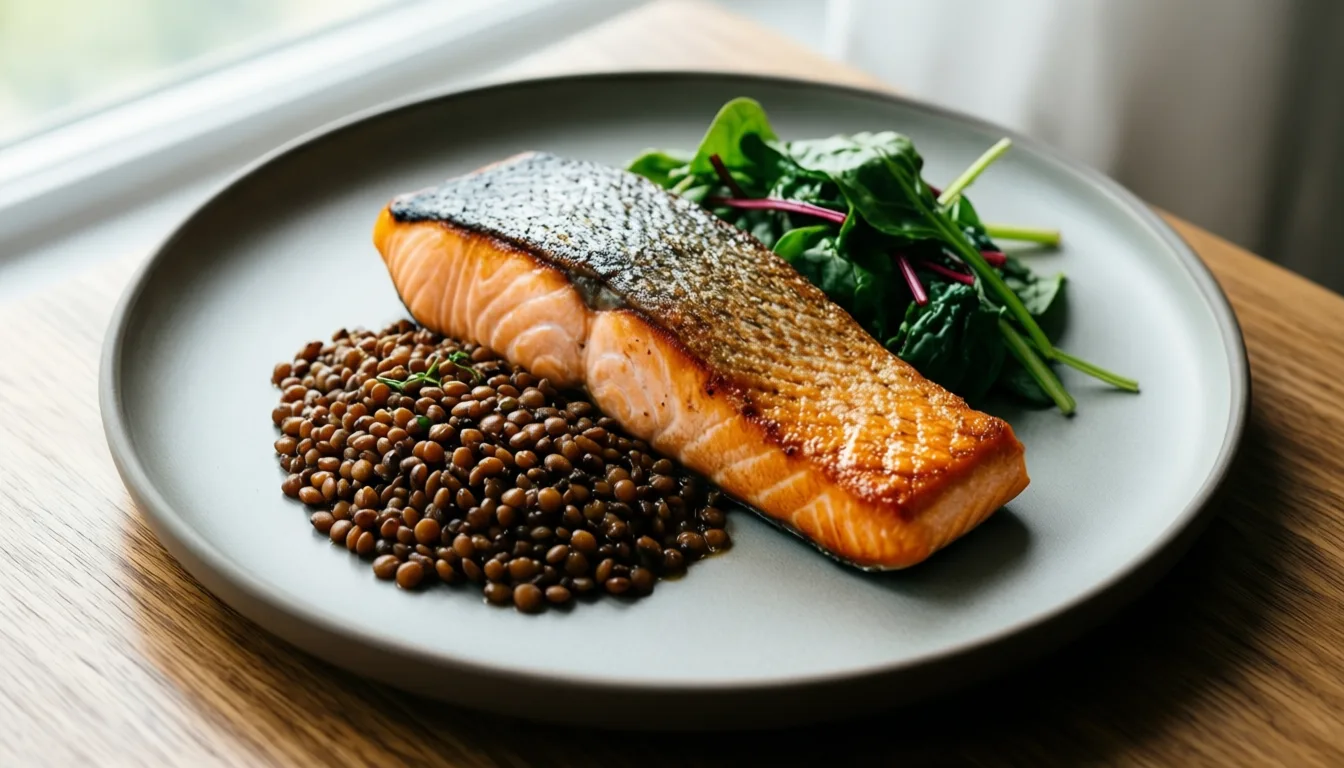
Protein-forward plates become harder to finish on incretin therapy, which is precisely why the review flags adequacy as a clinical priority.
The protein problem nobody warned you about
One of the more practical points in the synthesis is also the most counterintuitive: the drugs that make weight loss easy can make the muscle-sparing inputs harder. Appetite suppression is the mechanism, but it doesn't suppress selectively. Protein — the macronutrient most associated with satiety and most needed to defend lean mass during a deficit — is often the first thing that gets crowded out of a shrinking daily intake.
The review's nutrition guidance is direct in spirit if cautious in tone: ensure adequate intake and absorption of high-quality protein and micronutrients, and consider oral nutritional supplements when whole-food intake falls short. The authors do not prescribe a universal gram target, and neither should anyone reading a magazine. The shape of the recommendation, though, is clear: protein adequacy is not optional on these drugs, and many users are quietly under it.
Why resistance training is the non-negotiable
Cardio is not the lever here. The review specifically names resistance training as the modality shown to minimize loss of muscle mass and function during weight-reduction therapy. The mechanism is intuitive: a tissue exposed to a meaningful mechanical signal is a tissue the body is reluctant to break down for fuel, even in a deficit. Subtract that signal during rapid loss and the body takes the path of least resistance.
For the appearance-focused reader, the implication is that the gym session is not an aesthetic add-on during a GLP-1 protocol — it is the protocol's structural counterweight. Without it, the drug is essentially deciding the body-composition split on its own.

Resistance training is the modality the review singles out for protecting lean mass during rapid weight reduction.
- Track composition, not just weight. The number on the scale doesn't tell you which tissue is leaving.
- Treat protein as a clinical input. The review flags adequacy — sometimes via oral nutritional supplements — as a defense against lean-mass loss.
- Lift, deliberately. Resistance training is the activity modality with the most direct evidence for sparing muscle during weight reduction.
- Mind the micronutrients. Suppressed appetite tends to shrink dietary variety alongside calories.
- Loop in a clinician. Guidelines are still catching up; individualized monitoring matters more, not less, during that gap.
- Hold the language honest. Evidence here is moderate — direction is clear, optimal doses are not.
The honest read on the current evidence is this: incretin mimetics are a legitimately powerful tool, and the muscle question is not a reason to dismiss them. It is a reason to use them with a body-composition strategy rather than a weight-loss strategy. The Obesity Reviews synthesis does not promise that a protein-forward diet and a serious lifting program will fully neutralize the lean-tissue cost. It argues, with the caution the data warrants, that they are the most credible defenses currently on the table — and that patients on these drugs should be in comprehensive treatment programs built around them.
The glow-up version of that idea is simpler. The drug will lower the number. Whether the body underneath looks — and functions — like the one you wanted is a separate project, and it starts the day the first dose does.
Frequently asked questions
How much muscle do people typically lose while taking GLP-1 medications like semaglutide or tirzepatide?
In trial participants treated for 68 to 72 weeks, roughly 10% or more of skeletal muscle mass was lost alongside fat. The article describes this as approximately equivalent to two decades of age-related muscle loss compressed into a little over a year.
Why does losing muscle matter beyond just the number on the scale?
Muscle drives resting metabolism, glucose disposal, and the functional capacity that keeps a body looking athletic in motion rather than merely thin in photos. The review warns that significant muscle loss can translate into reduced functional and metabolic health, weight cycling, and compromised quality of life.
Why is getting enough protein specifically harder on GLP-1 medications?
The appetite suppression these drugs produce is not selective — it reduces overall food intake, and protein is often the first macronutrient crowded out of a shrinking daily diet. The article notes that protein-forward plates become harder to finish on incretin therapy, which is precisely why the review flags adequacy as a clinical priority.
Why does the article focus on resistance training rather than cardio for protecting muscle?
The review specifically names resistance training as the modality shown to minimize loss of muscle mass and function during weight-reduction therapy. The reasoning given is that a tissue exposed to a meaningful mechanical signal is a tissue the body is reluctant to break down for fuel, even in a caloric deficit.
Are there specific protein targets or training prescriptions users should follow?
The article is explicit that the review does not prescribe a universal gram target, and the authors note that formal protein targets and training prescriptions have not yet been fully established in updated guidelines. Any specific numbers seen online should be treated as working estimates, not settled standards, and decisions about supplementation or training load should be brought to a clinician familiar with the individual case.
Sources
- Strategies for minimizing muscle loss during use of incretin-mimetic drugs for treatment of obesity. — Obesity reviews : an official journal of the International Association for the Study of Obesity
Join the conversation
Comments are moderated and reviewed before they appear. Be constructive — this is health information.
Add your comment